My favorite tax strategy isn't a single move. It's two strategies running simultaneously, each effective on its own and considerably better paired.
Most investors accept whatever tax outcome their portfolio produces. The question worth asking is what you can do before the taxable event arrives, and how to build the tools to manage it while the portfolio is still compounding.
At STQ, we run two strategies most investors have never seen combined.
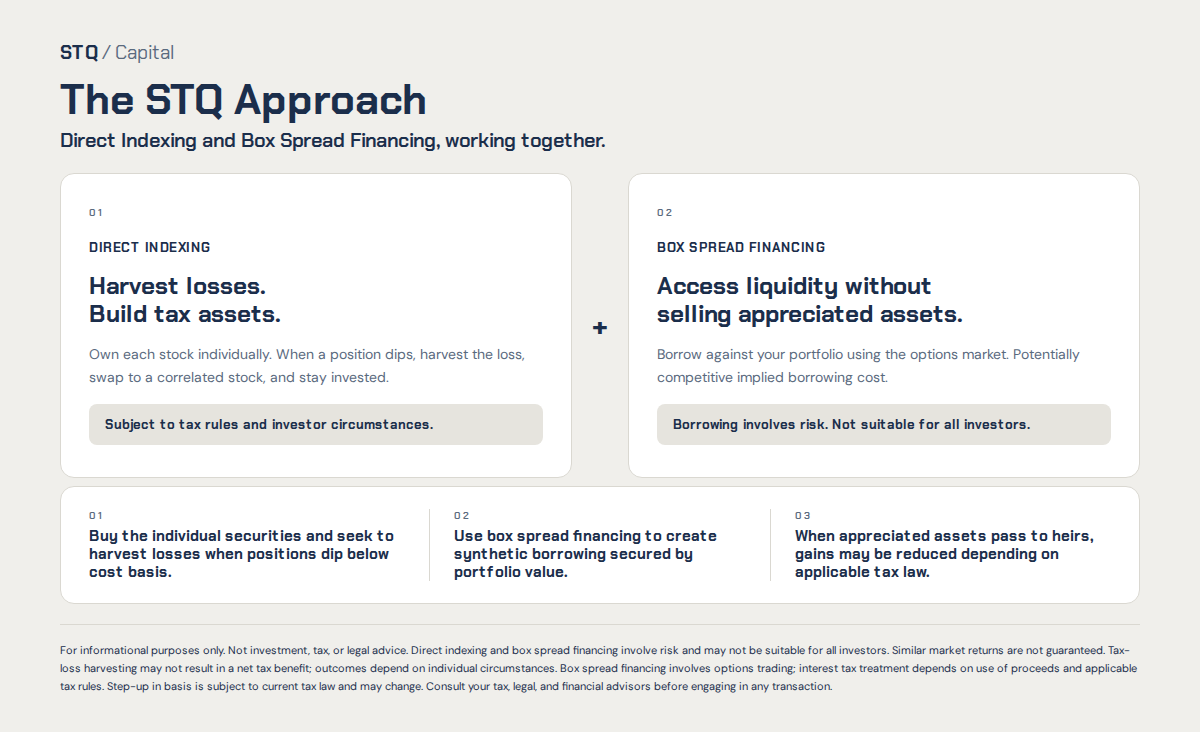
The Two Strategies
Why They Work Together
The problem most investors face is straightforward: their wealth is concentrated in appreciated assets, and accessing that wealth means selling, which triggers a capital gain.
The conventional response is to sell, pay the tax, and move on. The STQ Approach addresses both sides of the problem simultaneously.
You may have losses available to offset gains, and a potential path to access liquidity without selling the positions that generated those losses.
Direct indexing builds the tax asset: a continuously growing pool of harvested losses that may be available when a gain event arrives. Box spread financing provides the liquidity mechanism, a way to access cash without forcing the sale that triggers that gain event.
Most investors who need cash sell their appreciated positions, trigger the capital gain, and manage the tax bill afterward. The STQ Approach builds the offset and the liquidity mechanism in advance, so that when the event arrives, there are options.
The Longer-Term Goal
Taken to its logical conclusion, the STQ Approach supports what is sometimes referred to as Buy, Borrow, Die, a framework used by many long-term wealth builders and family offices for decades.
Who This Is For
The STQ Approach works best for investors with taxable portfolios and meaningful capital gains exposure: a business sale coming, real estate gains, significant equity compensation, or a concentrated stock position.
Investors anticipating a significant taxable event benefit most from building the loss bank early. The earlier direct indexing is implemented, the larger the potential offset when the event arrives.
Investors who need periodic liquidity without wanting to trigger capital gains are strong candidates for box spread financing as an alternative to selling appreciated positions or conventional margin borrowing.
Note: direct indexing does not benefit retirement accounts such as IRAs or 401(k)s. Tax loss harvesting only applies in taxable accounts. Box spread tax treatment depends on use of proceeds and individual circumstances, and should be discussed with a qualified tax advisor before implementation.
Direct indexing and box spread financing each involve risk and are not appropriate for all investors. This is not a recommendation to engage in any specific strategy. Consult your tax, legal, and financial advisors before engaging in any transaction.
Have a taxable portfolio and capital gains exposure? This combination may be worth a conversation.
Request a Portfolio Diagnostic