STQ
Synthetic Portfolio Borrowing

Box Spreads:
A Deep Dive.

Borrow against your investments at near-Treasury rates through box spreads. No bank approval, no credit check, no forced selling. Interest is structured as a capital loss – deductible against capital gains regardless of how proceeds are used. Funds typically available within days of execution.

Floating Line of Credit
~3.90%
SOFR + ~0.22% · current
1-Year Fixed
4.10%
Locked for 12 months
3-Year Fixed
4.01%
Locked for 36 months
5-Year Fixed
4.09%
Locked for 60 months

Rates as of 04/24/2026. Actual rates depend on market conditions and do not include management fees.

Borrow from the market, not the bank.

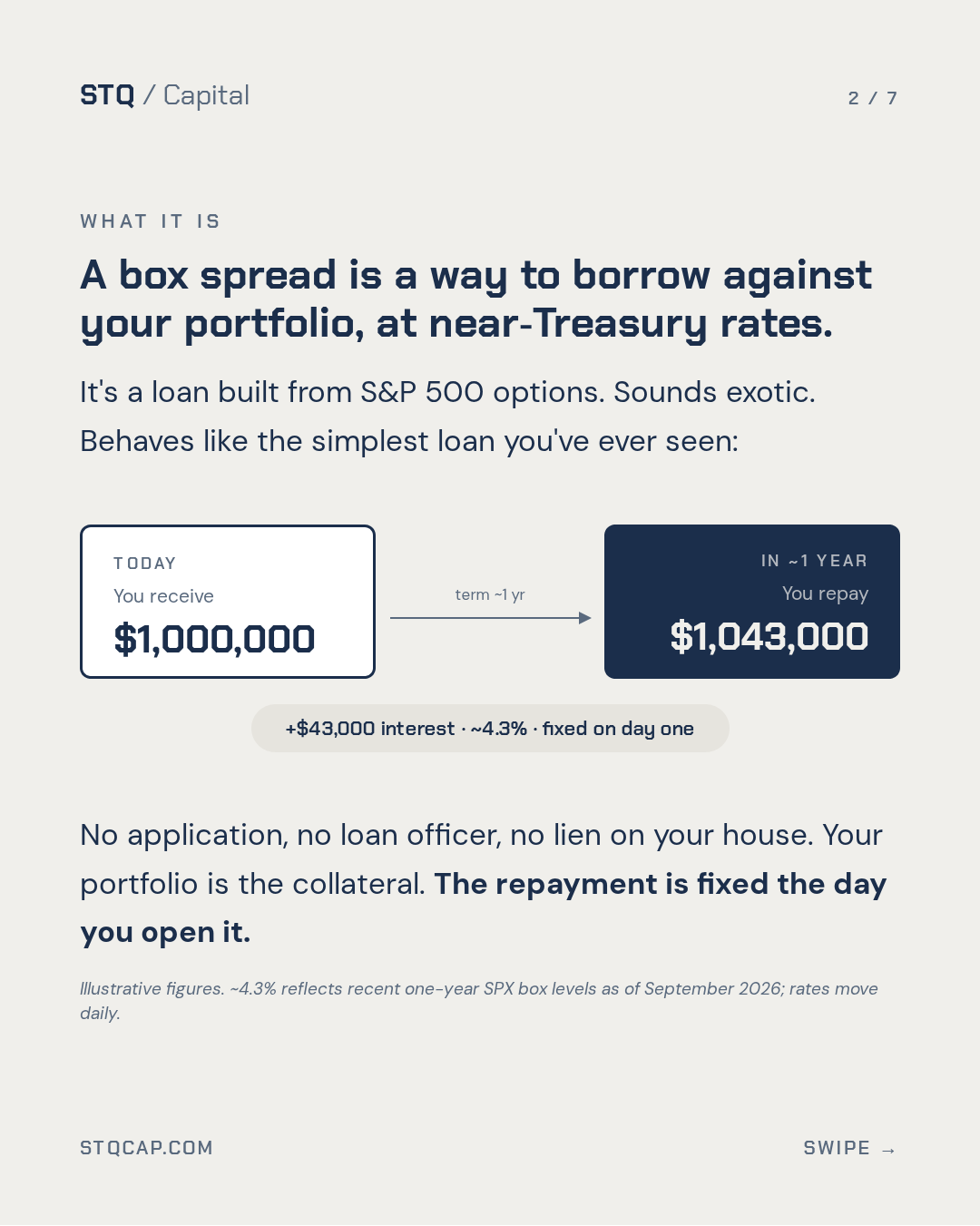
A box spread is a four-leg options structure on the S&P 500 Index that creates a fully hedged position with a fixed, known payoff at expiration. It functions like a zero-coupon bond – you receive cash upfront and repay a fixed amount at settlement.

The difference between what you receive today and what you owe at expiration is your interest rate – set by the options market, not by a bank. Institutional participants including options market makers and hedge funds compete to provide the capital, which is what keeps rates competitive.

At STQ, we implement this through an established institutional platform available through our custodian. Setup requires one DocuSign package. Funds are typically available within a few business days of execution.

01

Portfolio stays invested

Your existing holdings serve as collateral. Nothing is sold. You stay fully invested and continue compounding.

02

Box spread is executed

STQ facilitates a basket of four SPX index options on your behalf. The structure locks in a fixed payoff at expiration – your rate is set at trade time.

03

Funds available quickly

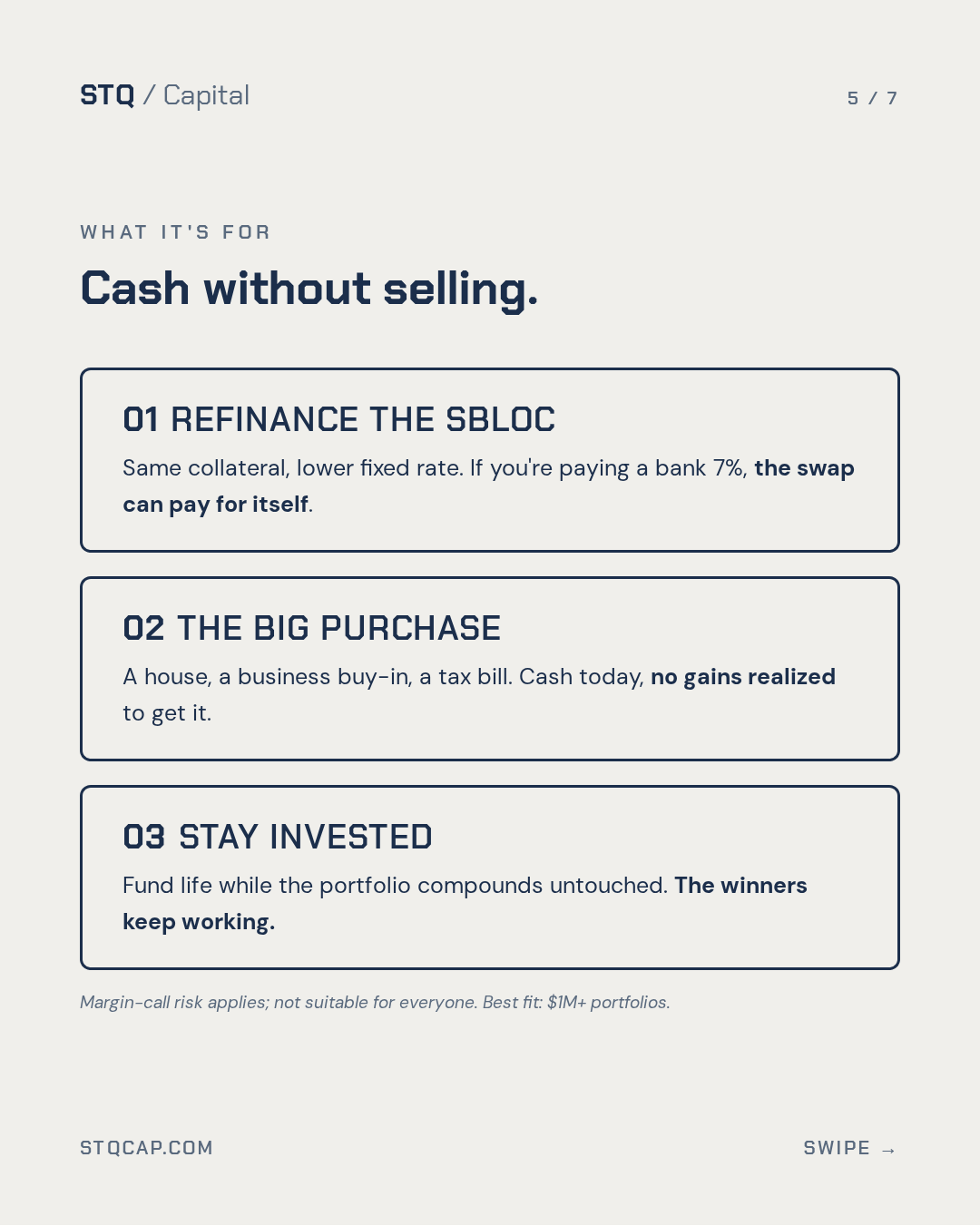
Proceeds are credited to your account. Minimum draw is $10,000. Borrow up to 50% of your portfolio – or up to 85% for portfolio margin accounts.

04

Interest is tax-deductible

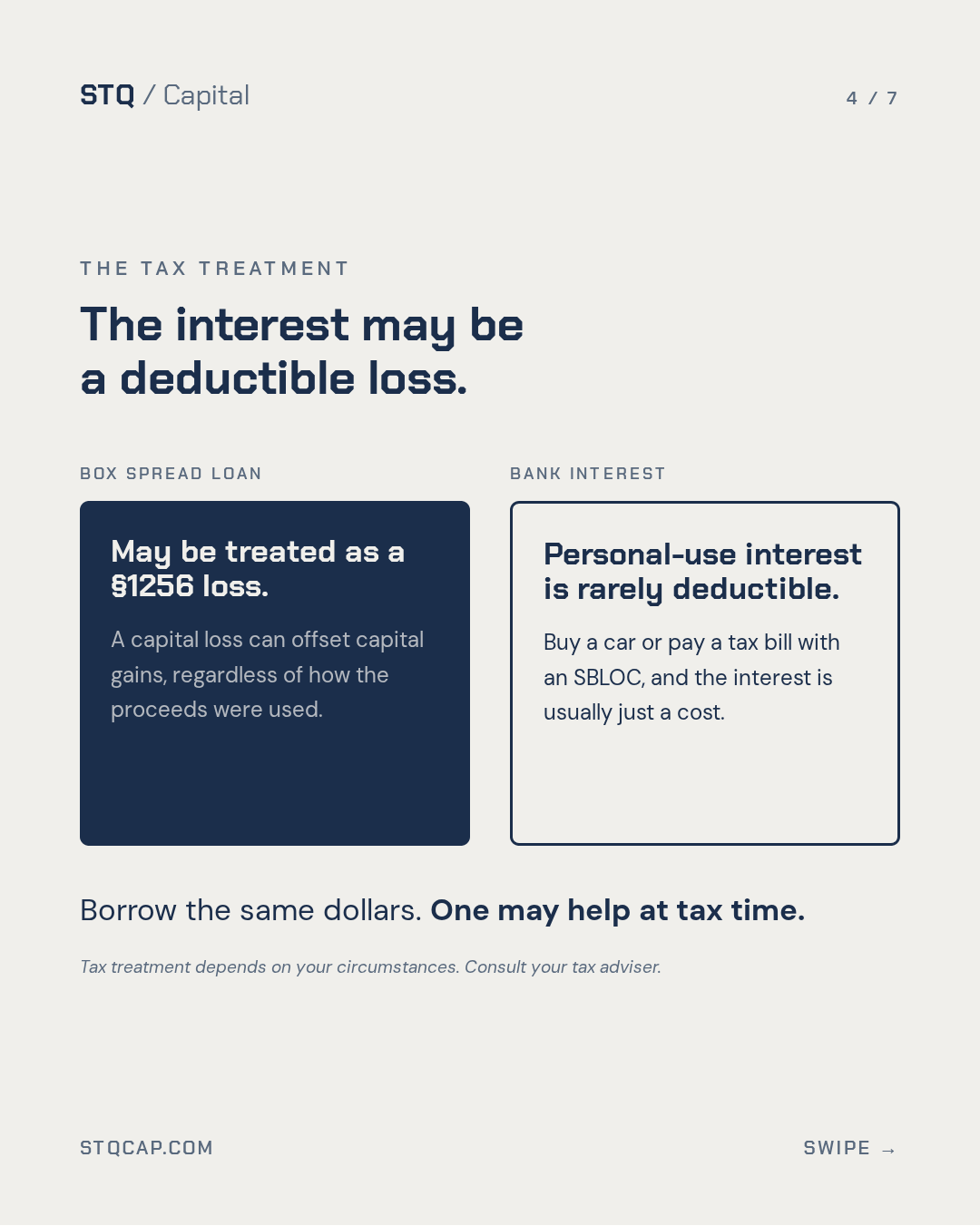
Because SPX options are Section 1256 contracts, interest is treated as a capital loss – 60% long-term, 40% short-term – reported on your 1099. No restrictions on use of proceeds.

Four advantages banks can't match.

~3.85%

Rates at or near Treasury

Because the rate is set by the options market – not a bank – you borrow at near-Treasury levels. The spread over SOFR is typically 0.20–0.37%. Compare that to margin loans at 10%+ or SBLOCs at 6.5–8%.

Any Purpose

Tax-deductible interest

Interest on box spread loans is treated as a capital loss under IRS Section 1256 – regardless of how you use the proceeds. Unlike margin loans or SBLOCs, there are no restrictions on purpose to claim the deduction.

$0

No forced selling

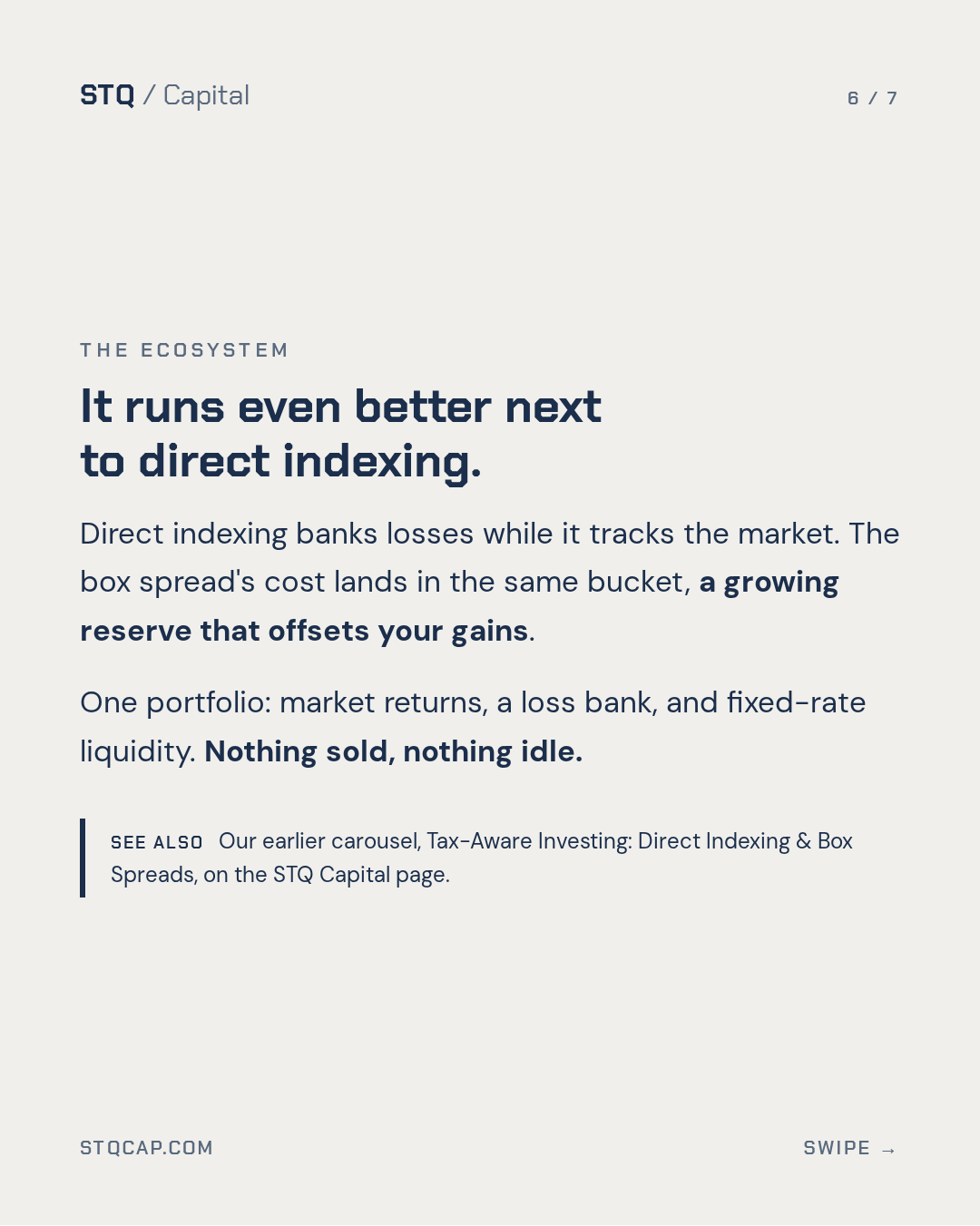
Your positions stay intact. No capital gains triggered. No disruption to your long-term investment strategy. The portfolio keeps compounding while you access the liquidity you need.

Simple

No bank, no application

No credit check, no underwriting, no approval process. Setup takes one DocuSign package. Early repayment – partial or full – is supported whenever markets are open.

Interest that works in your favor.

SPX index options are Section 1256 contracts under the IRS code. This gives them two distinctive tax treatments that make box spread borrowing uniquely advantageous.

Capital gains and losses are treated as 60% long-term and 40% short-term – regardless of how long the position was held. And positions are marked to market at year-end, meaning you can claim the deduction each year on accrued interest, even before the loan is repaid.

For a client in the top federal bracket, this means a meaningful portion of borrowing costs is effectively subsidized by the tax code. Your custodian reports the gains and losses on Section 1256 contracts as part of the consolidated 1099 – no special handling required.

Source: CBOE – SPX Options Product Specifications · Tax Treatment of SPX Options

60%
Long-term capital loss
40%
Short-term capital loss

How the deduction works

When you open a box spread loan, you receive the principal upfront and repay principal plus interest at expiration. The difference – your interest cost – is recorded as a capital loss on the options positions.

For multi-year fixed-rate loans, you claim the deduction annually based on accrued interest as reported on your 1099 – even if you haven't paid it yet.

The mechanics of a single-year loan

Box spread loan flow: receive $950K today, repay $1MM in 1 year, $50K interest = capital loss split 60/40 Today Receive $950K cash upfront $50K interest = capital loss 60% long-term – $30K 40% short-term – $20K In 1 year Repay $1MM fixed Deduction claimed on 1099 · Section 1256
vs. HELOC & SBLOC

The deduction others don't offer.

A HELOC is secured by your home. Interest is deductible only if the proceeds are used to buy, build, or improve the property – use the funds for anything else and the deduction disappears. A securities-backed line of credit is similarly restricted: interest is deductible only as investment interest expense under IRC §163(d), capped at your net investment income for the year, and only if the proceeds are used for investment purposes. Use an SBLOC to buy a vacation home or pay a tax bill and the deduction is disallowed entirely.

Box spread interest is different. Because it's classified as a capital loss under Section 1256 – not interest expense – the deduction applies regardless of what you do with the proceeds. Buy a vacation home. Pay a tax bill. Fund a business. The deduction follows the loan, not the use.

Box spreads
any purpose
~
HELOC
home use only
~
SBLOC
investment use only
Effective Rate

Why the real cost is under 3%.

The stated rate on a box spread is around 4%. But stated rate and effective rate are two different things.

Because the interest is classified as a capital loss under Section 1256, it generates a tax benefit that directly reduces your borrowing cost. The 60% long-term portion offsets capital gains you'd otherwise pay 20% on. The 40% short-term portion offsets gains taxed at ordinary rates. Combined, at top federal brackets, the tax savings reduce an approximately 4.10% stated rate to an effective cost of around 2.91%.

Illustrative – top federal brackets
Stated rate~4.10%
Blended federal tax benefit on capital loss~–1.19%
After-tax effective rate~2.91%

Illustrative only. Effective rate based on top federal tax brackets applied to the 60/40 long-term/short-term split. Actual results depend on your individual tax situation and whether you have offsetting capital gains. Consult a qualified tax advisor.

Multi-year fixed loan – annual deductions

Clients who want a fixed interest rate can enter into a box spread contract that lasts multiple years. In these cases, the interest is not paid until the options expiration date. These clients can claim a capital loss each year: for tax purposes, custodians will use the fair market value to calculate the losses on those contracts at the end of each year. The losses based on fair market value will be equal to the accrued interest for that year.

Multi-year deduction chart $9,700 $100 $100 $100 $10,000 Cash received upfront Year 1 Accrued interest Year 2 Accrued interest Year 3 Accrued interest Lump sum payment at expiration Year 1 tax deduction Year 2 tax deduction Year 3 tax deduction

Hypothetical $10,000 loan at ~1% annual interest over 3 years. Cumulative accrued interest shown. For illustrative purposes only.

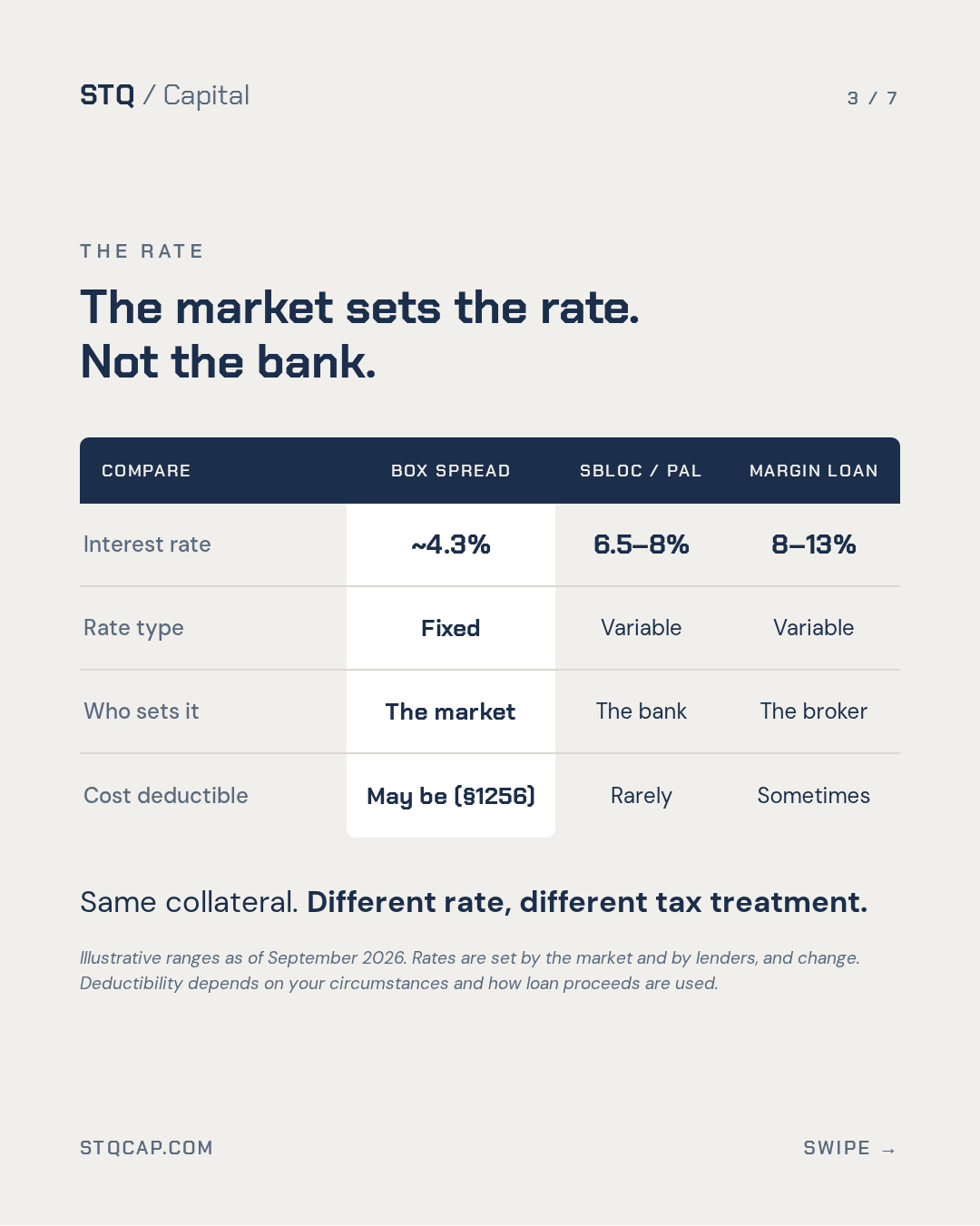
How box spreads compare.

Box Spreads (STQ) Securities-Backed Lines of Credit Margin Loans
Interest rate 3.85% – 4.00% 6.50% – 8.00% 10%+
Fixed-rate option Up to 6 years Limited availability Not offered
Tax deductibility Yes – any purpose Investment purpose only; capped at net investment income Investment purpose only; capped at net investment income
Minimum draw $10,000 $70,000+ N/A
Borrowing power Up to 50% (85% PM accts) 50%–70%, no concentrated Up to 50%
Margin call risk Lower – withstands 28.5%+ drop Higher – immediate call risk Standard – broker discretion; can be called at any time
Setup 1 DocuSign, funds available shortly after execution Bank application required Varies

Rates as of 03/30/2026. For illustrative purposes. Actual rates vary. Consult your advisor.

What people ask us.

What is a box spread, in plain English?
A box spread is a basket of four options contracts on the S&P 500 Index that creates a fixed, known payoff at a future date. It functions like a zero-coupon bond – you receive cash upfront and repay a fixed amount at expiration. The difference is your interest rate, set by the options market rather than a bank. Market participants including hedge funds and market makers provide the capital, competing to offer the lowest rate.
Does market volatility affect my loan?
Not your interest rate. Once a box spread is implemented, the interest expense is fixed and does not change with market movements. During the COVID downturn, box spread borrowing continued without interruption. Volatility can affect the value of your collateral – which could trigger a margin call if holdings drop significantly – but it does not affect the terms of your loan.
Can I repay early?
Yes. Both partial and full early repayment are supported whenever markets are open. When you repay, the box spread options are exited on the market – effectively selling the loan to other participants. There is no prepayment penalty.
Will I owe margin interest to my broker?
No. A margin account is required to use this strategy, but you will not owe margin interest to your broker. The funds come from the options market through box spreads – not from your broker-dealer. Your custodian's margin feature simply determines how much can be withdrawn from the strategy.
How is the interest rate set?
Floating rates are benchmarked to SOFR and adjusted monthly using 1–3 month box spreads. Fixed rates are benchmarked to same-duration Treasury yields and locked for the term of the loan. The rates are market-driven: when rates in the options market are too high, institutions invest in box spreads (increasing supply, reducing rates); when too low, they borrow (increasing demand, raising rates). This arbitrage keeps rates close to Treasury.
What paperwork is required?
Two items: a limited power of attorney (LPOA) granting trading and fee payment authorization, and an options and margin agreement to enable box spread trading in your account. Both are handled in a single DocuSign package. The account is typically set up within one week.
Who are the lenders?
Institutional market participants – options market makers, hedge funds, and other professional investors. You're borrowing directly from the institutional wholesale market, which is why rates are significantly better than what banks offer. The BOXX ETF, with over $10 billion in AUM, was created specifically to put institutional cash to work on the lender side of this market.
CBOE
SPX Options – Product Specifications
Official contract specs, settlement terms, and trading mechanics for SPX index options from the Chicago Board Options Exchange.
cboe.com →
CBOE
Tax Treatment of SPX Options
CBOE's overview of the Section 1256 tax treatment applicable to SPX index options, including the 60/40 long-term/short-term capital gain split.
cboe.com →
CBOE
SPX Options Strategies
Strategy guides for SPX index options from CBOE, including box spreads, risk reversals, and other multi-leg structures used by institutional participants.
cboe.com →
IRS
Publication 550 – Investment Income & Expenses
The IRS reference covering Section 1256 contracts, marked-to-market rules, and the treatment of capital gains and losses on regulated futures and index options.
irs.gov →

External links are provided for informational purposes only. STQ Capital Partners is not affiliated with CBOE or the IRS and makes no representations regarding the accuracy or completeness of third-party content.

Case Study: Financing a $1.5M Vacation Home

A $5M portfolio owner saves over $40,000 annually versus traditional mortgage financing.

The Situation: Investor with $5M portfolio wants to buy a $1.5M vacation home.

The Choice: Traditional 7% Mortgage vs. Box Spread Loan at ~4.10%.

Traditional Mortgage

Interest Rate 7.0%
$1.5M × 7.0% = $105,000 interest
Deductibility Cap $750k Limit
Only ~$52.5k of interest deductible
Tax Benefit ~$19,400
Net Annual Cost $85,600
Saves ~$42k / Year

Box Spread Loan

Implied Rate ~4.10%
$1.5M × 4.10% = $61,500 interest
Deductibility 100% Full
Entire $61.5k is deductible capital loss
Tax Benefit ~$17,800
Net Annual Cost $43,700

Hypothetical illustration for educational purposes only. Assumes top federal bracket. Mortgage deductibility subject to $750k acquisition debt limit under TCJA. Box spread interest treated as Section 1256 capital loss. Actual results depend on individual tax circumstances. Consult a qualified tax advisor.

Understand before you borrow.

Synthetic portfolio borrowing is a powerful tool – and like any leverage strategy, it carries risks that must be understood before use. Read these carefully. We discuss each of them in detail before implementation.

Primary Risk

Margin Call Risk

Box spread borrowing requires a margin-enabled account. If the value of your portfolio falls sufficiently, your broker may issue a margin call – requiring you to deposit additional assets or liquidate securities to restore minimum equity. This is the most significant risk associated with any form of securities-backed lending.

The strategy can generally withstand a portfolio decline of approximately 28.5% or more before a margin call is triggered, depending on your specific account composition. However, this threshold is not guaranteed and can change with portfolio concentration, asset class, and market conditions. Forced liquidation at depressed prices can result in permanent capital loss and unintended taxable events.

Primary Risk

Leverage & Amplified Loss Risk

Borrowing against your portfolio means that losses on your investments – and on whatever you deploy the proceeds into – are amplified relative to an unleveraged position. If both your portfolio and the investment funded by the loan decline simultaneously, losses can be substantial and may exceed the original amount borrowed.

Leverage is not suitable for all investors. The appropriateness of borrowing depends on your risk tolerance, overall financial picture, liquidity, and investment time horizon. This strategy should never represent a material portion of a portfolio without careful analysis.

Interest Rate Risk

Fixed-rate box spread loans lock in your borrowing rate at trade time – typically for terms ranging from 1 month to 6 years. If benchmark rates fall materially after you lock in, your rate will not adjust downward. For clients seeking flexibility, floating-rate structures using short-dated (1–3 month) box spreads are available and reset with prevailing market rates at each roll.

Execution & Liquidity Risk

Box spreads are traded on regulated options exchanges and require sufficient market liquidity to execute at favorable prices. In periods of extreme market stress or prolonged exchange disruptions, execution may be delayed or pricing may be less favorable than under normal conditions. In rare scenarios where a box spread cannot be rolled at expiration, the account may temporarily revert to a standard margin loan until conditions normalize.

Tax Treatment Risk

The favorable tax treatment of Section 1256 contracts – including the 60/40 long-term/short-term split and mark-to-market deductibility – is based on current IRS rules and established tax authority. Tax law can change. Additionally, the deductibility of investment interest expense depends on your individual tax situation, the purpose for which proceeds are used, and applicable income and AMT thresholds. Always consult a qualified tax advisor before implementing this strategy.

Suitability

This strategy is not for everyone.

Generally appropriate for investors who:

  • Hold a diversified, liquid investment portfolio of $250K or more
  • Have a clear and specific use for the borrowed capital
  • Can comfortably absorb a portfolio drawdown without forced selling
  • Understand the mechanics and risks of options-based leverage
  • Are working with a qualified advisor and tax professional

Generally not appropriate for investors who:

  • Are borrowing to fund speculative or highly illiquid investments
  • Have a concentrated or highly volatile portfolio with limited margin buffer
  • Cannot tolerate the possibility of a margin call in a down market
  • Are relying on the borrowed funds for essential living expenses
  • Have not reviewed the strategy in detail with a qualified advisor

The information on this page is provided for educational and informational purposes only and does not constitute investment, legal, or tax advice, nor is it an offer or solicitation to buy or sell any security. Synthetic portfolio borrowing through box spreads involves the use of options and margin, which carry significant risk including the potential for losses exceeding the amount invested. This strategy is not suitable for all investors. Past performance and hypothetical illustrations are not indicative of future results. Rates shown are indicative and subject to change based on market conditions at time of execution. Interest deductibility depends on individual tax circumstances and the use of loan proceeds – consult a qualified tax professional before implementing. STQ Capital Partners ("STQ") is an investment adviser registered with the State of California. Registration does not imply a certain level of skill or training. Advisory services are only offered to clients or prospective clients where STQ and its representatives are properly licensed or exempt from licensure. STQ facilitates box spread borrowing through third-party institutional platforms; STQ is not a lender, broker-dealer, or futures commission merchant. All borrowing arrangements are between the client and the relevant counterparties. Please review all program documentation carefully before participating.

Ready to Put Your Portfolio to Work?

Schedule a conversation to find out how much you can borrow, at what rate, and whether this strategy fits your situation.