One of the best financial strategies I’ve come across isn’t an investment strategy at all. It doesn’t require picking stocks, timing markets, or taking on more risk than you already have. It just requires knowing that your portfolio, the one sitting in your brokerage account right now, can function as a lender. Most investors never use it that way.
The strategy is called a box spread. And if you have a meaningful portfolio and have ever needed liquidity - for a down payment, a tax bill, a business opportunity, or a concentrated position you couldn’t sell - it is worth understanding.
How It Works
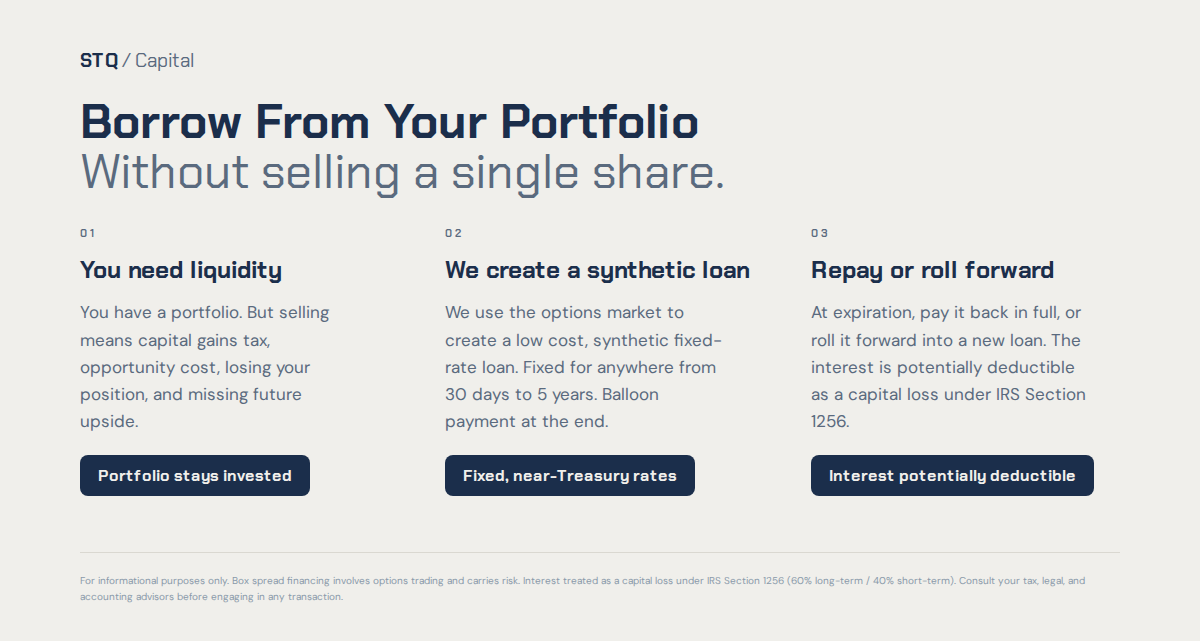
A box spread is a four-leg options structure executed on a major index like the S&P 500. The mechanics are straightforward: you sell a box spread, cash lands in your account, and you agree to repay a fixed amount at expiration. The difference between what you receive and what you repay is your effective interest rate - set by the market at the moment of execution, locked in for the life of the trade.
That rate has historically tracked close to Treasury rates - significantly below what most margin accounts, HELOCs, or bank loans will offer. You choose the term anywhere from three months to several years. At expiration you repay or roll it forward. Your portfolio stays fully invested throughout, and nothing is sold, so there is no taxable event.
No bank, no application, no credit check, and no forced selling. The rate is set by the market, not by a broker with a quota.
Who It’s For
Box spreads are most useful in three situations. First, when you need liquidity but don’t want to sell appreciated positions. Second, when you have a tax event on the horizon and want to access cash without adding to your taxable income. Third, when you see an opportunity - a real estate deal, a private investment, a time-sensitive purchase - and don’t want to restructure your entire portfolio to act on it.
You don’t need millions. But you do need options approval on your account and an understanding of the mechanics. Executed correctly, it is one of the most cost-effective liquidity tools available to individual investors. Most advisors aren’t familiar with it. We use it every day.
Box spread financing involves options trading and carries risk, including the risk of loss. Interest treatment as a capital loss under IRS Section 1256 may not apply in all circumstances. This is not a recommendation to engage in any specific strategy. Consult your tax, legal, and financial advisors before engaging in any transaction.
Want to know if box spread borrowing makes sense for your situation - and what rate you’d be looking at today?
Request a Portfolio Diagnostic